A conveyor stops with a box halfway through a transfer. The operator clears the fault and presses Reset. Should the sequence start again, finish the transfer or wait for inspection? A step number alone cannot answer that question. The controller needs a record of the intended operation and trustworthy evidence of the current physical condition.
Separate three kinds of information
Keep an operator request, the sequence state and the equipment feedback separate. StartRequested means someone asked to start; it does not mean a transfer is running. Step=Transfer describes the controller’s current intent; it does not prove that the box arrived. An exit sensor proves only the condition defined for that sensor, including its polarity and diagnostic status.
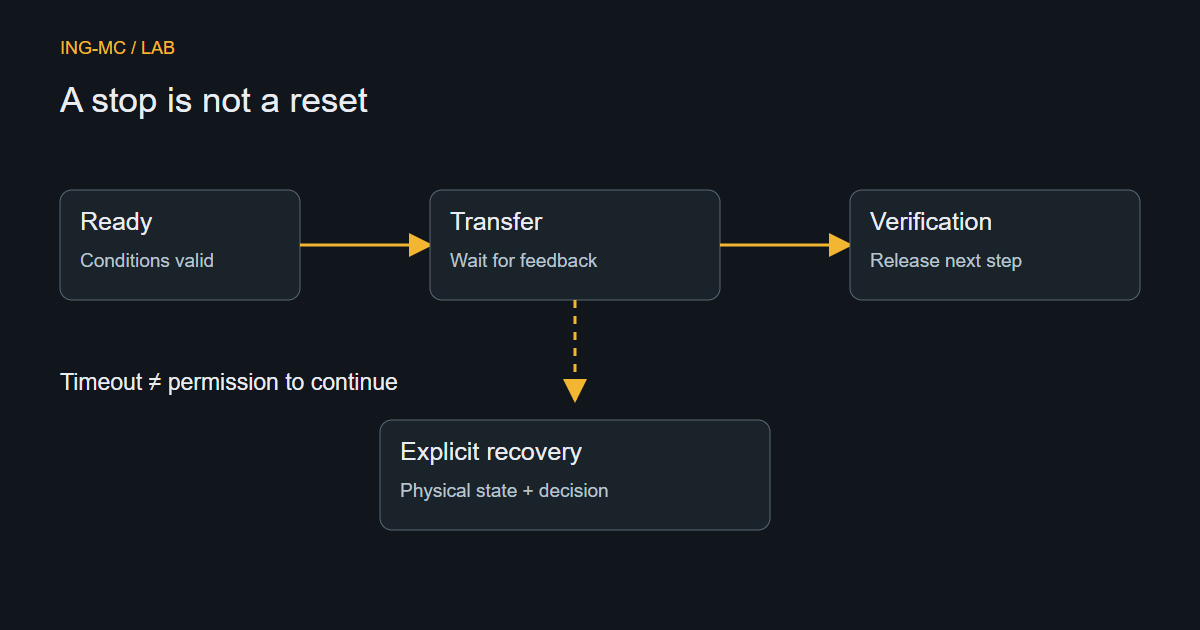
For a teaching transfer, use four normal states: Idle, CheckEntry, Transfer and VerifyExit. Add a recovery state rather than forcing every disturbance back to Idle. Record why a transition happened: completed feedback, operator stop, communication loss or timeout. A numeric code without a reason is difficult to troubleshoot.
Specify transitions before outputs
| Current state | Required evidence | Next decision |
|---|---|---|
| Idle | Valid start request and approved operating conditions | Check entry |
| Check entry | Entry occupied; destination available; readings valid | Begin transfer |
| Transfer | Expected arrival feedback | Verify exit |
| Verify exit | Transfer completion confirmed | Release the next request |
| Recovery | Known box position and reviewed recovery action | Finish, retract or wait |
This is a control-sequence example, not a safety design. Safety-related stops and restart prevention require their own machine-specific implementation. Do not use the table as a substitute for that assessment.
Define an output from the current state and the applicable operating conditions. Avoid latching a motor on in one routine and clearing it in an unrelated routine. A reader should be able to find both the output’s permission and the reasons it becomes unavailable.
Treat timeouts as missing evidence
A transfer timer should start when the step begins and reset when it ends. Expiration means the expected event did not arrive in the allotted window. It does not prove that the motor failed or that the sensor is broken. Show the expected condition, elapsed time and actual readings to help distinguish those causes.
Choose the time allowance from the actual process and validate it during commissioning. An animation duration from a web demo is not a valid equipment timeout. Also define what happens if feedback changes while paused: freezing the display must not freeze the controller’s understanding of the machine.
Reset clears a condition; it does not reconstruct reality
After a restart, retained step memory can disagree with the box position. Before permitting movement, compare the physical feedback against the candidate state. If both entry and exit sensors are active, or neither can be trusted, stop the normal sequence and request a defined recovery decision.
A practical review asks: Can a held request execute twice? Can manual mode move equipment without updating the sequence context? Does clearing a fault also unintentionally issue Start? Is the reason for waiting visible on the HMI? What happens when power returns during a transfer?
Try the state distinction
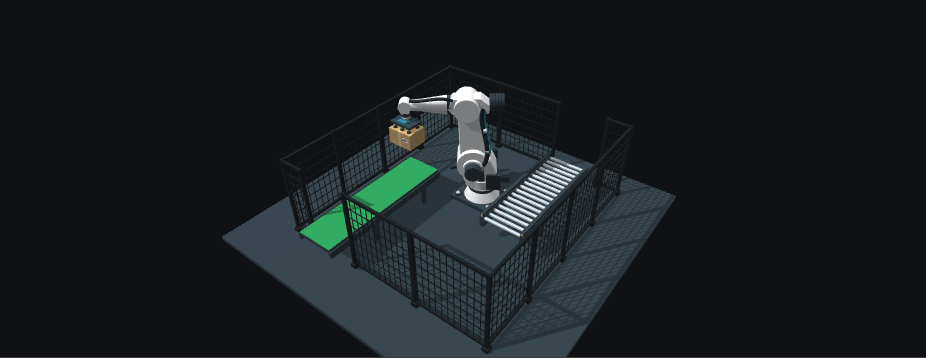
In Robot Pick & Place, pickup ends in holding; placement is valid there, while Home is not. Pause preserves the unfinished browser step. Compare those guards with the sequence guide, then write the physical evidence your real application would need before adopting a similar pattern.
For a bench review, list every state, its entry condition, outputs, completion evidence, timeout and recovery action. Test each transition with fabricated input records before connecting equipment. Keep the table with the PLC project so the HMI and diagnostics use the same vocabulary.